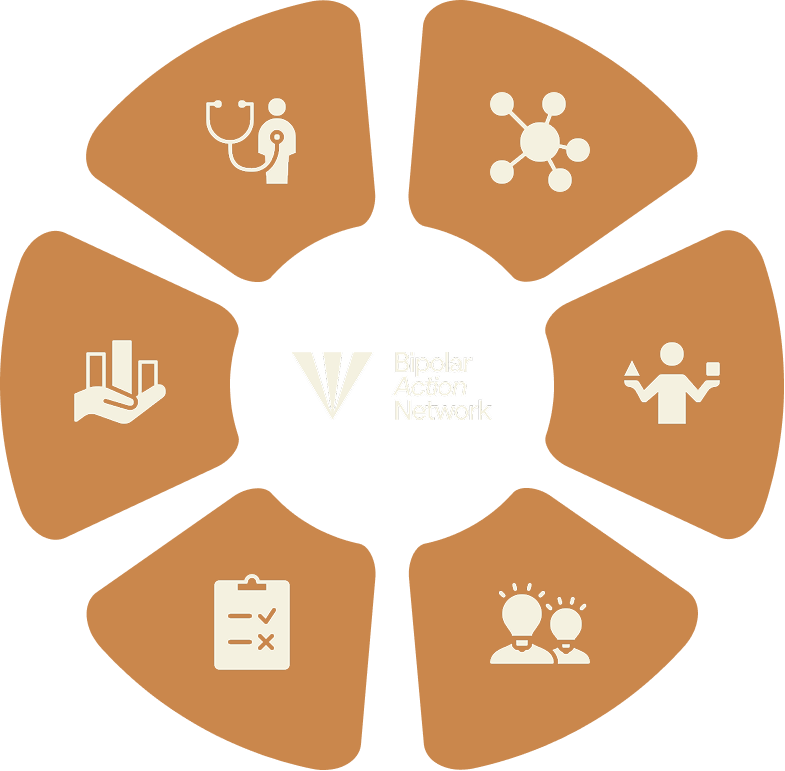
The Bipolar Action Network (BAN) is an innovative model of collaboration and continuous learning that brings together patients, families, researchers, clinicians, health administrators, and industry specialists to improve care for bipolar disorder.
Using patients’ and families’ real-world experiences, we identify what is and isn’t working and use these insights to inform quality improvement projects, give direction to research, and accelerate discovery. As we discover more effective practices, we share what we’ve learned with our partners, thus improving outcomes for all.
How BAN Works
The Bipolar Action Network functions like a feedback loop, continuously collecting and analyzing data from patients’ everyday care to drive improvements.
1
Gather Data
Collect clinical & patient-reported data and securely store
2
Measure Outcomes
Evaluate data to assess treatment effectiveness
3
Identify Ideas for Improvment
Use data and input from network community to identify areas for improvement and potential solutions
4
Test New Ideas
Test potential solutions in quality improvement (Q) trials
5
Measure & Share Post-Trial Outcomes
Analyze results of QI trials and communicate across network
6
Adopt What Works
Implement successful practices and findings across network
The Bipolar Action Network is based on a proven model for positive change in medical care:
The Learning Health Network.
From Crohn’s disease and ulcerative colitis to kidney disease, learning health networks have significantly improved health outcomes for numerous diagnoses:
65%
Solutions for Patient Safety has achieved significant national impact, including a 65% reduction in adverse drug events and measurable declines in multiple hospital-acquired conditions across more than 140 children’s hospitals.
25%
ImproveCareNow increased remission rates for pediatric IBD patients by 25% (from ~55% to ~80%) over a decade by using a learning health network model.
73%
IROC Centers have controlled blood pressure in 73% of patients, compared to 57-65% reported in published literature.
The Bipolar Action Network is based on a proven model for positive change in medical care:
The Learning Health Network.
From Crohn’s disease and ulcerative colitis to kidney disease, learning health networks have significantly improved health outcomes for numerous diagnoses:
65%
Solutions for Patient Safety has achieved significant national impact, including a 65% reduction in adverse drug events and measurable declines in multiple hospital-acquired conditions across more than 140 children’s hospitals.
25%
ImproveCareNow increased remission rates for pediatric IBD patients by 25% (from ~55% to ~80%) over a decade by using a learning health network model.
73%
IROC Centers have controlled blood pressure in 73% of patients, compared to 57-65% reported in published literature.