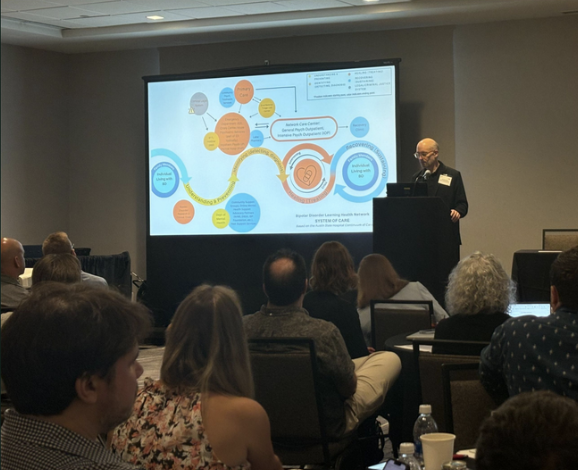
Learning Session 5 took place in Boston, MA on February 4-5, 2026.
During this meeting, we:
Deepened understanding of stakeholder roles and foster shared purpose and community
Celebrated network achievements and collaboratively set goals for upcoming improvement cycles
Streamlined CGI data collection workflows and address barriers to effective implementation
Expanded quality improvement and leadership skills to empower participants and sustain progress
Established comprehensive measures for bipolar care and align collaborative goals to drive meaningful improvements
Focused on diagnostic accuracy, population management, and data-driven learning with shared goals and metrics
October 9, 2025
Learning Session 4
Learning Session 4 took place virtually on October 9, 2025.
During this meeting, we:
Engaged in peer storytelling and solution design to test improvement ideas
Practiced leadership by applying small, high-impact actions inspired by others’ successes
Facilitated discussions between experts by experience and clinicians to shape priorities
Refined data collection workflows and troubleshoot CGI barriers
Developed and committed to SMART aims for the next 90 days
June 23 & July 17, 2025
Learning Session 3
Learning Session 3 was held virtually across two sessions on June 23 and July 17, 2025.
During this meeting, we:
Refined the draft change package developed with Health Management Associates to strengthen our shared approach to improving care.
Aligned on a unified framework to guide improvement efforts across the network.
Collaborated virtually to review progress, gather feedback, and ensure coherence in our next steps.
March 13-14, 2025
Learning Session 2
The Cincinnati Ohio site hosted Learning Session 2 on March 13-14, 2025.
During this meeting, we:
Shared and celebrated our progress to date.
Continued to build quality improvement and leadership skills.
Identified priority areas for improvement.
Collaborated to develop and advance promising innovations and change ideas.
November 18-19, 2024
Learning Session 1
The first learning session for the Bipolar Action Network took place in Cincinnati, OH, on November 18-19, 2024.
During this meeting, we:
Defined members’ roles in the network.
Described the patient and family experience of living with bipolar disorder.
Discovered variations in practice across care centers.
Utilized team dynamics to connect and build a shared network culture.
Generated improvement goals for the next 90-day action period.
Designed PDSAs for testing new ideas to improve care for bipolar disorder by accelerating equitable improvements.
June 24-25, 2024
Design Meeting 3
Design Meeting 3 for the Bipolar Action Network (BAN) took place in Covington, KY on June 24–25, 2024.
During this meeting, we:
Demonstrated the results of the BAN Design Challenges.
Continued learning about how to improve care and outcomes together.
Worked to ensure that we continued laying the groundwork for real collaboration and partnership across roles and care centers.
March 19-20, 2024
Design Meeting 2
The Dauten Family Center site hosted Design Meeting 2 in Boston, MA, on March 19-20, 2024.
During this meeting, we:
Fostered community building and solidified the vision and values of the network.
Collaboratively refined aims, measures, and change ideas related to improving bipolar disorder care and outcomes.
Strengthened skills and expertise in quality improvement and human-centered design.
November 8-10, 2023
Design Meeting 1
The inaugural design session for the Bipolar Action Network took place in Cincinnati, OH, on November 8-10, 2023.
During this meeting, we:
Developed community, connection, empathy, and partnership among participants.
Oriented participants to their role in the Network so that they can change the current system of care using human-centered design and quality improvement methods using their creativity and innovative ideas.
Participated in creating a vision for a system of care to meet the needs and goals of individuals with lived experience, families, and clinicians affected by bipolar disorder.
Described what we know about the current state of the system of care for people living with bipolar disorder and identify what we need to learn to improve the system.
Began to develop the design of an improvement framework for the Bipolar Action Network.